


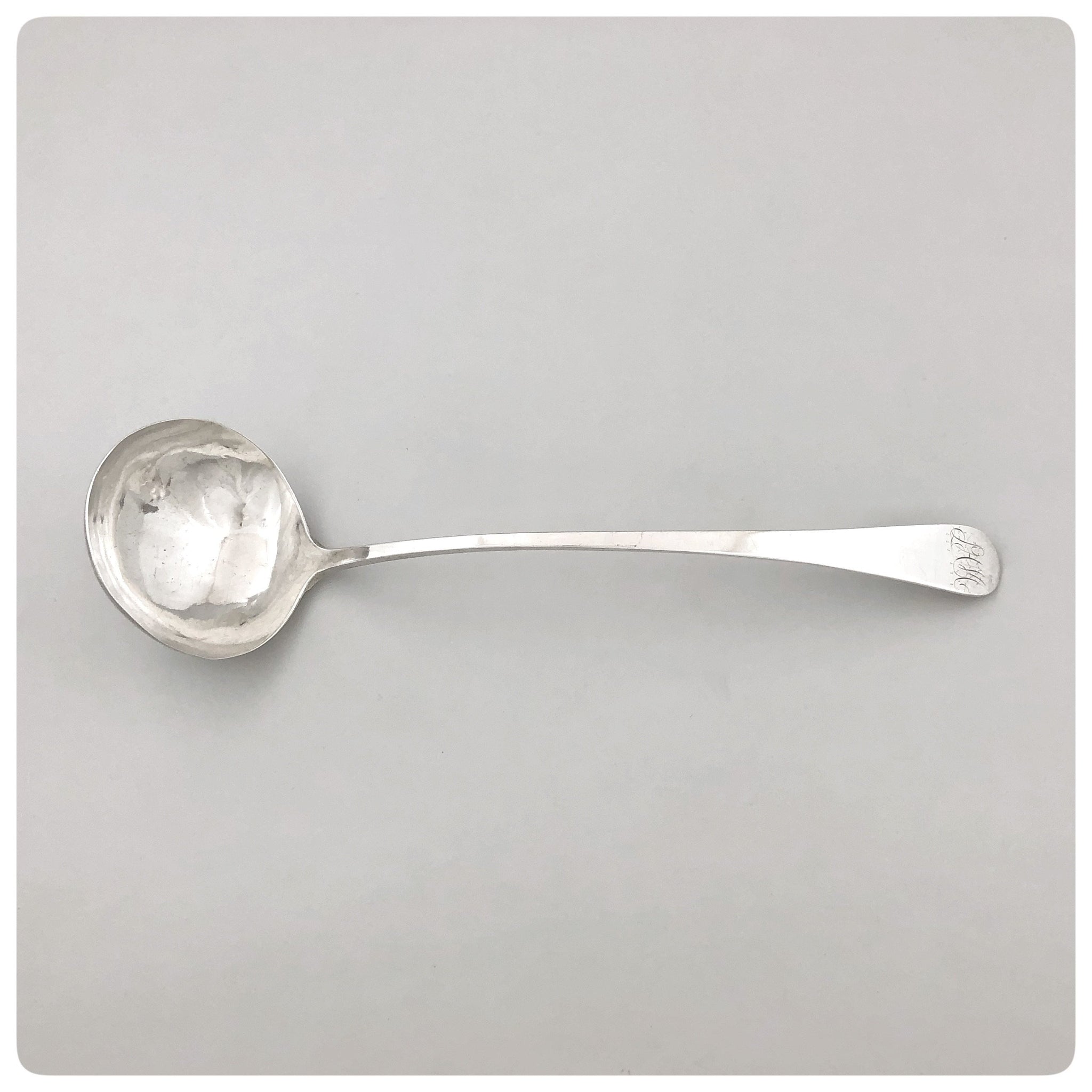
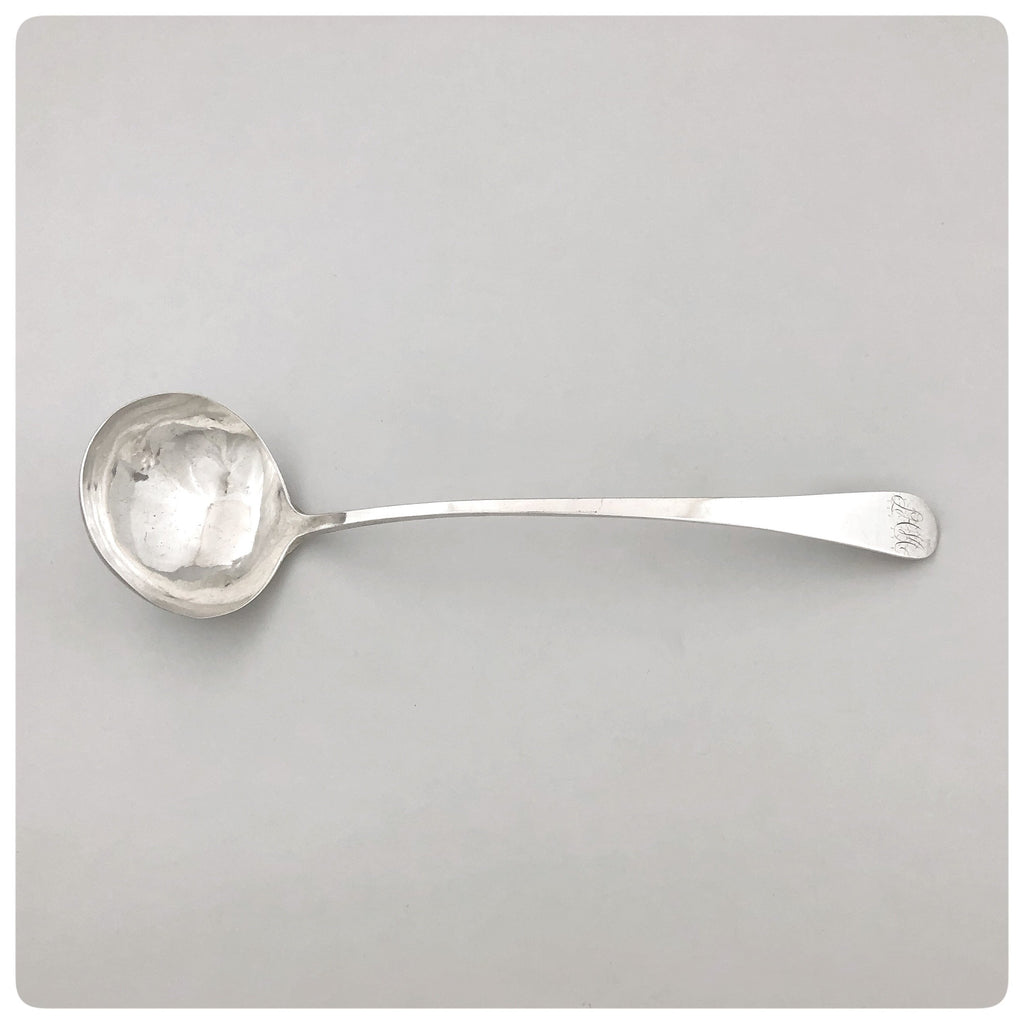
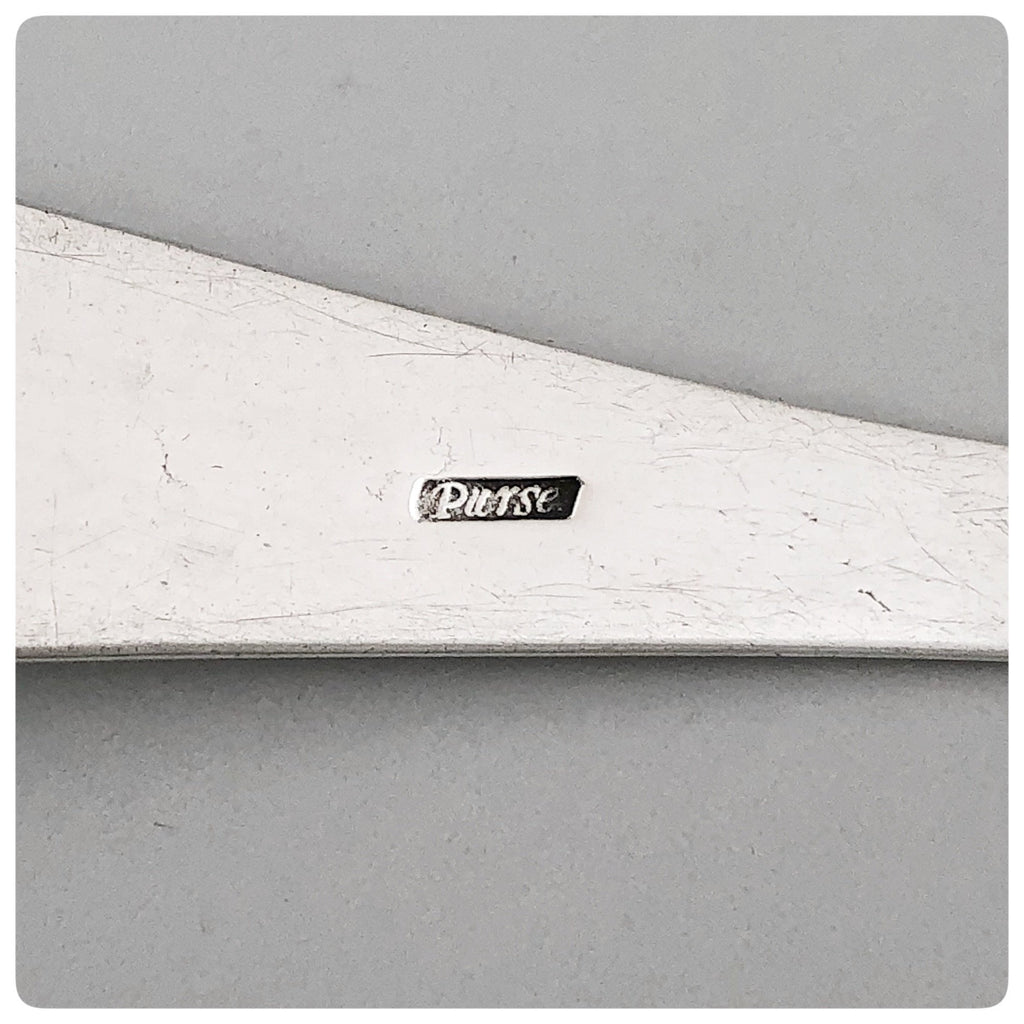
Coin Silver Soup Ladle, William Purse, Charleston, SC, Working 1785 to Circa 1825
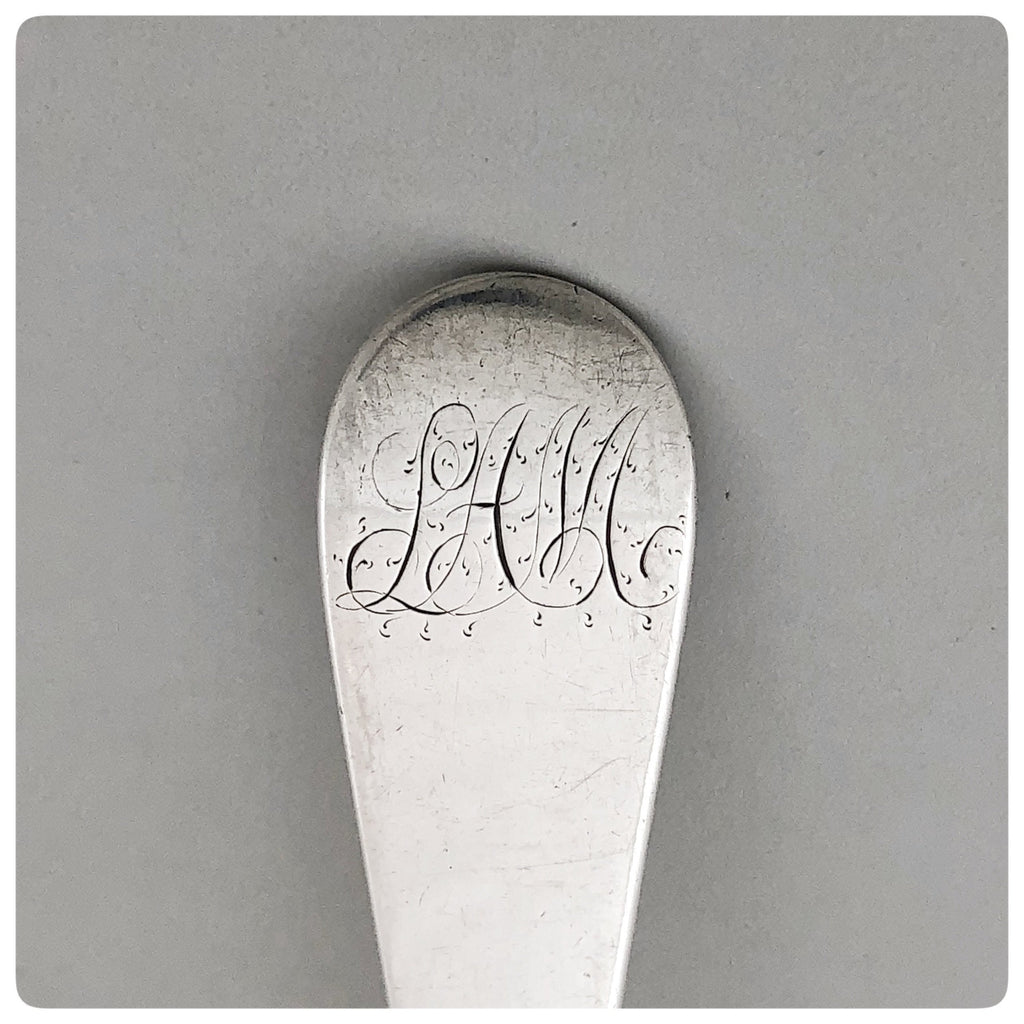
Engraved "LAM", likely for Colonel Lewis V. Morris and his wife Ann Elliott.
Colonel Lewis Morris (1754–1824) was a distinguished Revolutionary War officer and political leader who connected the elite societies of the South Carolina Lowcountry and New York. As the son of Lewis Morris, a signer of the Declaration of Independence, he achieved military acumen serving as an aide-de-camp to General Nathanael Greene during the southern campaigns of the Revolution. He became a prominent fixture in Charleston society after marrying the wealthy local heiress Ann Elliott, through whom he acquired extensive rice plantations and the historic townhouse at 34 Meeting Street. Morris shaped early American governance, serving as a delegate who voted to ratify the U.S. Constitution in 1788 and later serving as the Lieutenant Governor of South Carolina from 1794 to 1796. His enduring ties to the region are marked by his burial in Charleston's historic St. Michael's Churchyard.
It is unclear if William Purse was born in Charleston or if he immigrated to the Holy City as a young child. He is first recorded as a silversmith when he stood surety for the school master/silversmith, Amos Pilsbury, in 1798. According to Ensko, Purse plied his trade at 112 Broad Street until 1803. Later, he worked at 117 Broad Street, 96 Broad Street and 58 Broad Street. In 1810, Purse and fellow silversmith, Peter Mood, Sr., served as one of the administrators for the estate of silversmith John Meurset. He married Elizabeth Hammett on May 1, 1793, and achieved respect within the community, being appointed as administrator/executor of numerous estates. Purse also served as a lieutenant in the 1st Battalion of the 28th Regiment, Forrester Light Infantry. He succumbed to catarrhal fever in December 1844 and interred in St. Philip's Church cemetery.
Few pieces by Purse exist.
Measurements
13 3/4" length.
